What Most Astoria Homeowners Get Wrong About Area Rug Cleaning Specialized Care
Roughly 85 percent of area rug damage we see in Astoria was preventable and most of it traces back to decisions made at home, not in our van. Area rug cleaning specialized care in Astoria is something we handle week in, week out across this neighborhood, from the pre-war apartments stacked along Ditmars Boulevard to the newer condos near the Kaufman Studios corridor. Last spring, a homeowner on 34th Avenue called us after a handwoven Turkish kilim she had owned for over a decade started to bleed color badly. She had soaked it in her bathtub with dish soap after a cooking spill. The dye ran, the fringe distorted, and the backing stiffened. The rug was salvageable, but the restoration added real cost that the original cleaning would never have required. That call is not unusual. We hear a version of it every few weeks.
The Problems We Diagnose Most Often and What Actually Caused Them
Understanding what goes wrong with area rugs and why is the core of professional care. Below are the most common issues we encounter in Astoria homes, along with honest diagnostic reasoning and the professional response.
Dye Bleeding and Color Migration
Symptoms: Colors bleed into adjacent areas; a red border runs into a cream field; the rug looks muddied after cleaning.
Likely cause: Excess water, alkaline cleaners, or heat applied to rugs with unstable or fugitive dyes. This is especially common in hand-knotted wool rugs from Iran, India, and Turkey many of which use natural dyes that are pH-sensitive. Astoria has an unusually dense collection of these rugs because of the neighborhood’s large Greek, Egyptian, and South Asian communities, where ornate wool and silk pieces are heirlooms passed between generations.
Professional fix: We test every unfamiliar rug for dye stability before any moisture touches it. A small dye-bleed test on an inconspicuous corner, combined with a pH check on our cleaning solution, tells us exactly how cautious to be. For fugitive-dye rugs, we use low-moisture methods and controlled drying in a flat position. Dye stabilizers are applied where appropriate.
Can this be prevented? Yes. Never wet-clean a hand-knotted or antique rug at home without knowing its dye composition. When in doubt, call us first a quick question cost nothing.
Shrinkage and Backing Distortion
Symptoms: The rug no longer lies flat; corners curl; the backing has stiffened or developed a ripple.
Likely cause: Oversaturation during cleaning, followed by slow or uneven drying. Natural fiber rugs wool, cotton, jute absorb water deeply. When the foundation fibers get saturated and then dry unevenly, they contract at different rates. We see this in apartments with poor airflow, which is common in older Astoria buildings where cross-ventilation is limited.
Professional fix: Controlled extraction removes the bulk of moisture immediately after cleaning. We hang rugs or lay them flat in our facility for monitored drying. For distorted rugs already in this condition, we use blocking techniques stretching the rug square under tension during drying to restore its original dimensions.
Can this be prevented? Absolutely. The single biggest home mistake is leaving a wet rug on a hard floor or bunched in a pile. Even a fan pointed at a flat rug on a clean surface is better than nothing. Professional drying infrastructure is the real solution, though.
Fiber Damage from the Wrong Vacuum or Brush
Symptoms: Pile looks fuzzy, matted, or has visible fiber breakage; high-pile rugs look flat; shag fibers tangle.
Likely cause: Beater-bar vacuums used on delicate pile, or stiff brushes scrubbing wet fibers. A beater bar is designed for wall-to-wall carpeting. On a hand-tufted or loop-pile rug, it pulls at the structure aggressively. We see this damage constantly in Long Island City and Astoria, where residents move between apartments and bring new vacuums without adjusting settings.
Professional fix: Fiber damage is largely irreversible once it happens. We can groom pile and trim fuzz, but broken fibers are gone. For rugs still in good condition, we use low-agitation equipment calibrated for the pile type. Suction-only settings on a quality vacuum work fine for home maintenance.
Can this be prevented? Yes — turn off the beater bar or use the bare-floor setting. Vacuum in the direction of the pile, not against it.
Moth and Pest Damage Hiding Under a Clean Surface
Symptoms: Thin patches in the pile; visible larvae or webbing on the underside; small holes that seem to appear from nowhere.
Likely cause: Wool rugs stored in low-light, low-traffic areas are prime targets for moth larvae. In Astoria, we see this in rugs laid under heavy furniture a large sectional sofa on a Turkish wool rug is practically a moth nursery. The pile under the sofa goes undisturbed and unvacuumed for months. According to the American Lung Association, carpets can hold up to four times their weight in dirt, debris, and allergens and that same embedded organic material provides food for pests.
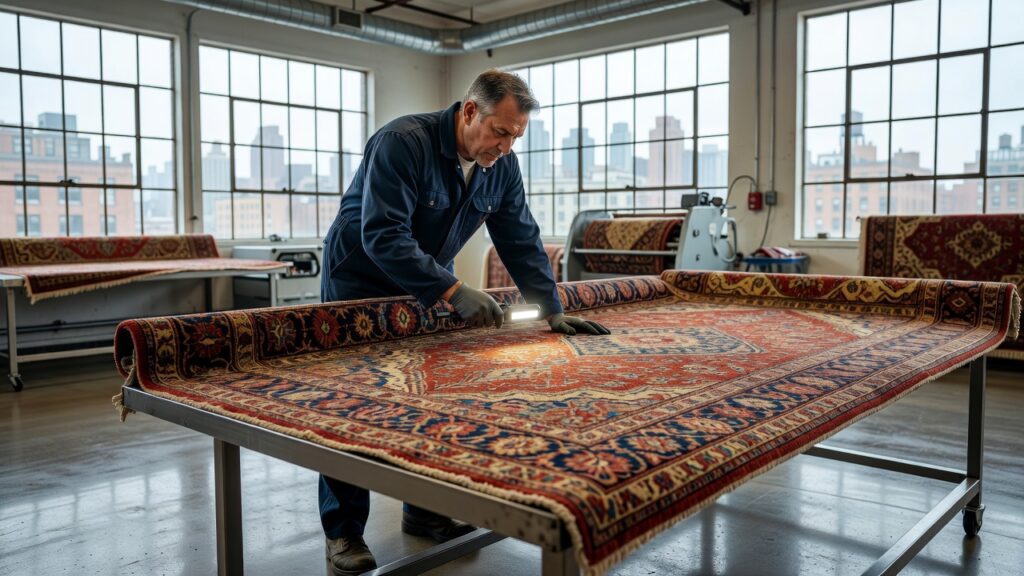
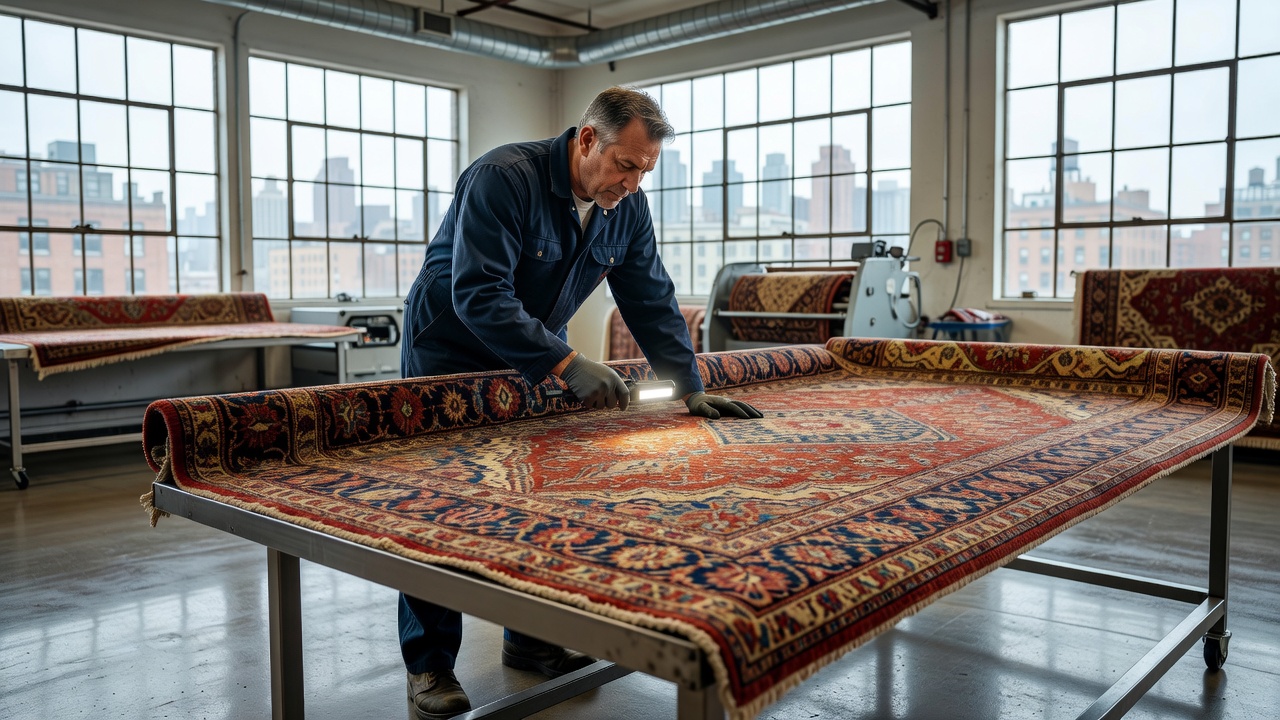
Professional fix: We inspect the full underside of every rug brought to us. Active infestations require treatment before cleaning. We also look at the pile under UV light to assess the extent of damage. Fiber reconstruction is possible for limited damage; severe cases require a specialist reweaver.
Can this be prevented? Move your rugs at least seasonally, vacuum both sides, and rotate their position under furniture. Rugs in storage should be cleaned first, then wrapped never stored dirty.
Detergent Residue That Attracts More Soil
Symptoms: A cleaned area gets dirty faster than the rest of the rug; a sticky or stiff feel in previously treated spots.
Likely cause: Over-application of consumer spot cleaners or dish soap. These products leave residue that the fibers cannot fully shed. Residue is sticky, and sticky fibers grab airborne particulate aggressively. New York City’s density over 27,000 residents per square mile in Manhattan, with comparable figures across Astoria and the broader Queens corridor means more foot traffic, more door-to-door particulate, and faster resoiling when residue is present.
Professional fix: We rinse thoroughly with a pH-neutral rinse solution and extract residue before it can set. For rugs already suffering from chronic residue buildup, a full immersion wash at our facility is often the most reliable reset.
Can this be prevented? Use as little spotting product as possible. Blot never scrub and rinse with plain water after any spotter. If the stain does not lift easily, stop and call us before the chemistry gets complicated.
Why Astoria Rugs Need a Different Approach Than Midtown Office Carpet
The rug inventory in Astoria is genuinely diverse. Within a single block you might find a machine-made polypropylene runner in one apartment, a hand-knotted Persian in the next, and a flat-weave dhurrie below a rooftop terrace. The Institute of Inspection, Cleaning and Restoration Certification (IICRC) recommends professional cleaning at least every 12 to 18 months, but for households with children, pets, or high foot traffic which is most of Astoria that interval often needs shortening. Specialty fiber rugs require a professional who reads the construction and fiber content first, not one who applies the same method to everything.
We also serve customers across neighboring areas regularly Woodside, Jackson Heights, Sunnyside, and over to Forest Hills and the diversity of rug types across western Queens is genuinely unlike anywhere else in the city. That range is exactly why we invest in multiple cleaning methods rather than defaulting to one.
Why Choose Adam’s Carpet Cleaning in Astoria
We are a working crew, not a call center. When you contact us, you speak with someone who has actually cleaned rugs in Astoria buildings, navigated the freight elevators in older walkups on Steinway Street, and carried rolled rugs down four flights in a July heat wave. According to the Environmental Protection Agency, indoor air can be 2 to 5 times more polluted than outdoor air, and carpets and rugs are among the primary traps for the allergens and particulate that drive that number. We take that seriously. Our process accounts for your rug’s specific construction, fiber, age, and condition not a one-size pricing tier.
We offer free pickup and delivery across Astoria and the surrounding neighborhoods, and our turnaround is honest we tell you how long drying actually takes, not what sounds good on the phone.
Contact Adam’s Carpet Cleaning NYC today to schedule a pickup or get a straight answer about what your rug actually needs. No pressure, no guesswork.
Frequently Asked Questions
How often should area rugs in Astoria apartments be professionally cleaned?
For most Astoria households, once a year is a reasonable baseline. Rugs in high-traffic areas, homes with pets, or units near busy streets like Ditmars Boulevard or 31st Street tend to accumulate soil and pollutants faster than suburban homes. The IICRC recommends professional cleaning every 12 to 18 months at minimum, but if your rug shows visible soiling, flattened pile, or odor before that interval is up, don’t wait. Earlier cleaning is almost always easier and less costly than delayed cleaning.
Can I clean my hand-knotted or antique area rug at home?
Dry vacuuming is generally safe if you use the right settings suction only, no beater bar, in the direction of the pile. Anything involving water, soap, or stain removers on a hand-knotted, antique, or natural-fiber rug carries real risk of dye bleeding, shrinkage, or fiber damage. These rugs have properties that mass-market cleaning products are not designed for. Area rug cleaning specialized care in Astoria means knowing the difference before you apply anything. When a spill happens, blot it dry and call a professional before using any product.
How long does professional area rug cleaning take, and do you pick up in Astoria?
Yes, we pick up and deliver across Astoria and surrounding neighborhoods in Queens. Cleaning and drying typically takes two to four days depending on the rug’s fiber content, thickness, and current condition. Wool rugs take longer to dry than synthetic ones, and we will not return a rug until it is fully dry returning a damp rug causes exactly the kind of backing and odor problems we are trying to prevent. We will give you a realistic timeline when we assess the piece, not an optimistic guess designed to close the booking.
Related from Adams Carpet Cleaning NYC: Rug Cleaning Bronx — Seasonal-Deep Care for Every Fiber, Every Neighbo · And Eco Friendly Care Manhattan
Our services
And Eco Friendly Care Manhattan · And Eco · And Eco Friendly Care Manhattan · An Eco · And Eco · Rug Cleaning Bronx