Your Carpet Is Telling You Something: Pet Odor Carpet Cleaning New York City Guide for Flushing Residents
Pet odor carpet cleaning in New York City is not a service most Flushing pet owners think about until the smell stops being ignorable. We get calls from Queens households constantly someone’s guests mentioned something, or a landlord sent a notice, or the odor came back three days after a DIY scrub. Last spring, a family in Flushing’s Kingsland Avenue corridor called us after their golden retriever had been having accidents on the same section of hallway runner for several months. They had rented a grocery-store steam machine twice. The smell kept returning. By the time we arrived, urine had soaked through the carpet backing and into the subfloor padding a situation no consumer-grade machine can reverse. That story is more common than we’d like to see.
This post is not here to scare you. It is here to give you a practical read on what you are actually dealing with, what you can handle yourself, and what genuinely needs a professional to resolve before it becomes a much bigger problem.
What Makes Flushing Apartments Especially Vulnerable
Flushing is one of the most densely occupied neighborhoods in Queens. Many of the residential buildings along Main Street, Kissena Boulevard, and the side streets off Northern Boulevard were built decades ago with carpet already installed over thin padding and plywood subfloors. That combination absorbs pet urine fast. New York City’s density over 27,000 residents per square mile in Manhattan, and comparable levels in dense Queens corridors means foot traffic, humidity, and enclosed air all work against you. A wet pet stain in a Flushing apartment with the windows closed in July does not dry clean. It sets.
Add to that the fact that many Flushing renters share ventilation systems with neighboring units, and odors travel. We have been called to apartments in Bayside and Fresh Meadows for odors that actually originated in a pet-occupied unit on a different floor. The problem compounds quickly when left alone.
Eight Warning Signs You Should Not Ignore
Here is what to actually look and smell for and what each sign means in plain terms.
1. The smell returns within 48–72 hours of cleaning. This is the clearest sign that urine has penetrated beyond the carpet fiber into the padding or subfloor. Surface cleaning removes what is sitting on top. The bacteria causing the odor lives deeper. Keep an eye on it: No. Call a pro now.
2. You can see a distinct yellowing or stiffness in the carpet pile. Dried urine crystallizes in carpet fibers and creates a rigid, slightly discolored patch. In natural or daylight, it often looks like a faded or bleached area. This means the deposit is old and concentrated. A damp cloth will not touch it. Call a pro now.
3. Your pet keeps returning to the same spot. Dogs and cats have a sense of smell roughly 10,000 to 100,000 times more sensitive than ours. If they sniff and mark the same corner repeatedly, the odor compound is still present at a molecular level even if you cannot detect it. Keep an eye on it if it just started; call a pro if it has been happening for more than two weeks.
4. The odor is noticeably stronger in humid weather. Uric acid crystals reactivate with moisture. If your Flushing apartment smells fine in February but becomes unbearable in July, that is a humidity-activated odor signature. It will not resolve on its own through any amount of baking soda or store-bought spray. Call a pro now.
5. You notice the smell in an adjacent room where your pet does not go. Odor travel through shared HVAC, baseboards, or subflooring gaps means the contamination has spread beyond the visible stain. This is especially common in older Queens apartment stock. Call a pro now.
6. There are multiple stain sites across more than one room. One or two isolated spots can sometimes be managed with an enzymatic cleaner if caught within hours. Multiple sites across a larger area represent a cumulative load that consumer products cannot neutralize effectively. According to the American Lung Association, carpets can hold up to four times their weight in dirt, debris, and allergens and pet waste compounds add biological material on top of that. Call a pro now.
7. The carpet has a sticky or tacky feel underfoot in a specific area. This means you are walking on residue — either from the original accident or from cleaning products that were not fully extracted. Residue left in carpet fibers attracts new soil rapidly and can feed odor-producing bacteria. Keep an eye on it if just discovered; call a pro if it persists after a second cleaning attempt.
8. You or someone in your household is experiencing increased allergy or respiratory symptoms indoors. According to the Environmental Protection Agency, indoor air can be 2–5 times more polluted than outdoor air, and carpets trap allergens, dust mites, and bacteria that contribute to poor indoor air quality. Pet dander, urine particulates, and secondary bacterial growth in soiled carpet all contribute to this. If symptoms are noticeably better when you leave the apartment, your carpet may be the cause. Call a pro now.
Where DIY Genuinely Stops Working
Enzymatic cleaners from the pet store work but only under specific conditions. They need direct contact with the urine deposit, enough dwell time (usually 10–15 minutes minimum), and they must be fully extracted afterward. Most people apply them, blot once, and move on. That is not a treatment. That is surface management.
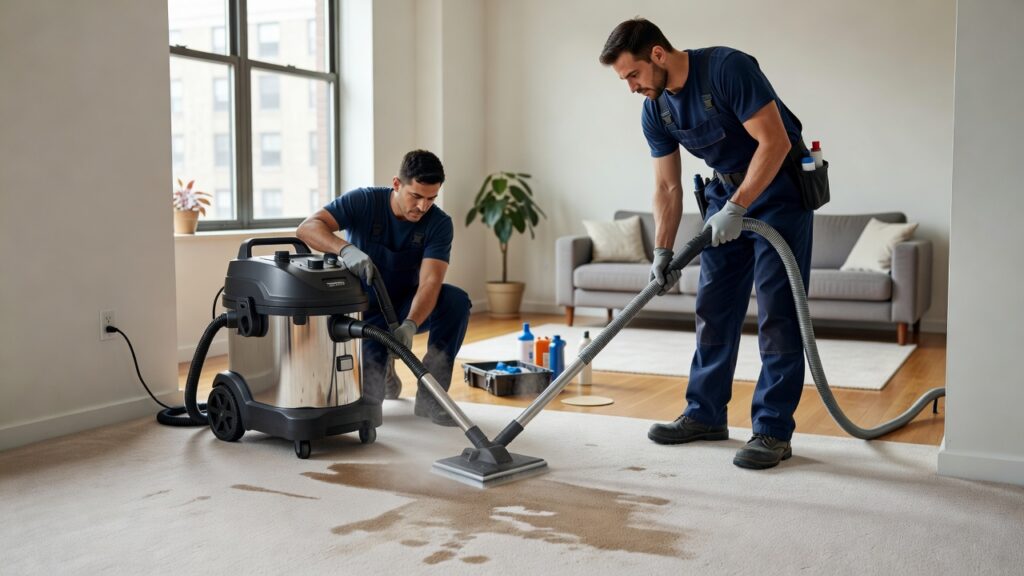
Consumer carpet machines rent for around $40–$60 per day in Flushing, and most hold clean water in one tank and dirty water in another. They do not apply heat at the level professional truck-mounted systems reach. The IICRC recommends that residential carpets be professionally cleaned at least every 12–18 months and that interval drops considerably in pet households. A truck-mounted hot water extraction system reaches temperatures and suction levels that pull urine deposits out of the padding layer, where the problem actually lives. Rental machines work at the fiber surface. That gap is not marketing language it is physics.
If you have tried cleaning twice and the odor persists, you have passed the DIY threshold. The same applies if the stain is older than a week, if your pet has been repeatedly using the same area, or if the carpet is over a concrete subfloor (common in lower-floor Flushing units), which holds odor compounds differently than wood.
Why Choose Adam’s Carpet Cleaning in Flushing and Across Queens
We work throughout Queens every week Flushing, Jackson Heights, Woodside, Forest Hills, Jamaica, and neighborhoods in between. We know the building stock. We know what carpet types are common in the prewar and postwar apartments along Flushing’s main corridors, and we bring the right treatment approach for each situation rather than a one-size solution. Our pet odor treatment process includes a pre-treatment enzyme application, hot water extraction with commercial-grade equipment, and a neutralizing rinse not just a surface pass. For serious contamination, we also assess whether padding replacement is necessary before treatment, which saves customers money versus treating carpet that cannot be salvaged without addressing what is beneath it.
We have handled situations in apartments from Murray Hill, Queens to Rego Park and over in Brooklyn’s Flatbush and the pattern is consistent. The households that call us early spend less and get better results. The ones who wait until the smell is overwhelming, or until a landlord is involved, face a harder road.
If you recognize more than two or three of the warning signs above in your Flushing apartment, reach out to us at Adam’s Carpet Cleaning NYC. We offer honest assessments, clear pricing, and the kind of local knowledge that matters when the building you live in was built in 1962 and the carpet has seen three tenants before you.
Frequently Asked Questions
How much does pet odor carpet cleaning cost in New York City for a Flushing apartment?
As of 2026, professional pet odor carpet cleaning in Flushing and the surrounding Queens area typically ranges from $150 to $350 for a standard one- to two-bedroom apartment, depending on the extent of contamination, the number of affected areas, and whether padding treatment or replacement is required. Apartments with multiple heavily soiled areas or subfloor penetration will fall toward the higher end. We provide clear estimates before any work begins so there are no surprises.
Can professional cleaning remove pet odor completely, or will it always come back?
In most cases, yes professional hot water extraction combined with enzyme-based pre-treatment can permanently eliminate pet odor when the contamination has not penetrated beyond the padding into the subfloor. If the subfloor is affected, carpet and padding may need to be replaced in the problem area before cleaning the surrounding carpet. We assess this before we start, not after, so you know what outcome to realistically expect.
Is it safe to stay in the apartment during and after professional pet odor carpet cleaning?
Yes. The products we use for pet odor treatment are safe for people and pets once dry, which typically takes two to four hours depending on ventilation and humidity — both of which vary in Flushing apartments depending on the floor and season. We recommend opening windows during and after treatment if possible, and keeping pets off the cleaned area until it is fully dry to avoid resoiling while the fibers are still open from extraction.
Related from Adams Carpet Cleaning NYC: And Eco Friendly Care Manhattan · Dry Carpet Cleaning in Manhattan, NY